Airworthiness Limitations (ALS/AWL): Airbus vs Boeing/ #EASA vs #FAA approach

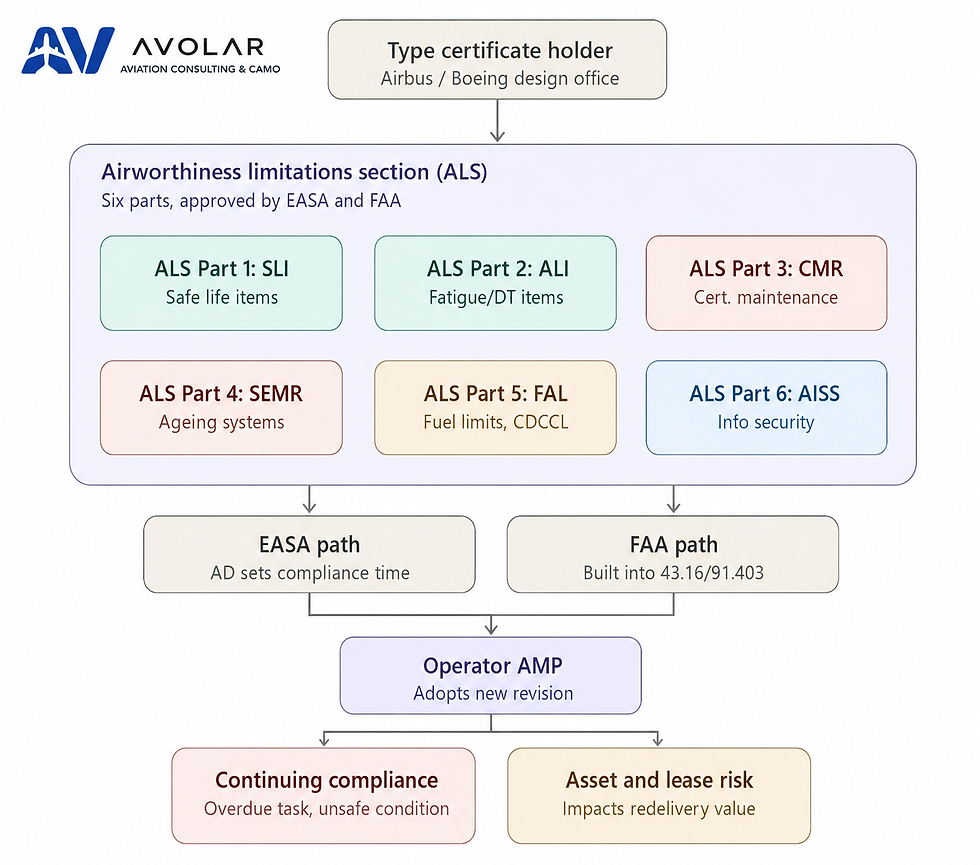
ALS/AWL is one of the most critical parts of an aircraft's ICA, because it contains maintenance tasks and limitations that preserve the safety assumptions made during aircraft certification.
Airbus definition for #ALS:
ALS Part 1, #SLI (Safe Life Items): parts that cannot use damage tolerance logic, so they get a hard life limit instead.
ALS Part 2, #DT-ALI (Damage Tolerant ALI): fatigue-critical structure inspected on a schedule, this is where CDCCL-related structural items and WFD (Widespread Fatigue Damage) inspections live.
ALS Part 3, #CMR (Certification Maintenance Requirements): tasks born out of the certification safety analysis (CS 25.1309), meant to catch hidden failures before they combine into something catastrophic.
ALS Part 4, #SEMR (System Equipment Maintenance Requirements): ageing systems maintenance, mostly EWIS and system-related tasks that don't fit CMR logic.
ALS Part 5, #FAL (Fuel Airworthiness Limitations): post-SFAR88 fuel tank safety tasks; this is the direct home of #CDCCL.
ALS Part 6, #AISS (Aircraft Information System Security): the newest addition, covering cybersecurity limitations tied to EU 2023/203 type concerns.
Unlike MPD tasks, which are developed to optimize maintenance planning, ALS tasks are certification-driven. They originate from structural fatigue analysis, DT assessments, system safety assessments, fuel system safety analyses, and certification requirements under CS 25 or FAR Part 25. These analyses identify maintenance actions that are essential to maintaining the aircraft's approved type design throughout its operational life.
This raises another frequently asked question.
Why does EASA issue an AD to mandate Airbus ALS revisions, while the FAA usually does not issue an AD every time Boeing updates its AWL?
The answer lies in the regulatory approach rather than in the engineering philosophy.
EASA issues an AD for each ALS revision. Not because the tasks aren't already mandatory; they are, from day one of type design approval. The AD exists because Part M never specified a compliance time for a new revision, so EASA uses the AD purely to set that clock.
Boeing doesn't follow the same pattern. The FAA rarely issues a dedicated AD for a routine ALI revision. Does that mean it's optional? No. Under 43.16 and 91.403, the ALS itself carries FAA approval, and the mandate is written straight into the regulation; no separate rulemaking event is needed per revision.
Same safety intent, two different legal mechanisms. And it matters operationally: on Airbus fleets, your AD register tells you your ALS status. On Boeing fleets, it won't. You have to track ICA/AWL revisions directly against 91.403, because there may be no AD trail at all.
I've seen this exact gap missed during redelivery reviews more than once. Worth checking twice.


Comments